This section explains the regular expressions used in “Redirect Handling During URL Corrections,” providing part-by-part explanations and common usage examples. Please use this as a reference.
For information about redirects, please also refer to “Manage 301 redirects by Redirection”
Actual Conversion Example
Part-by-Part Explanation
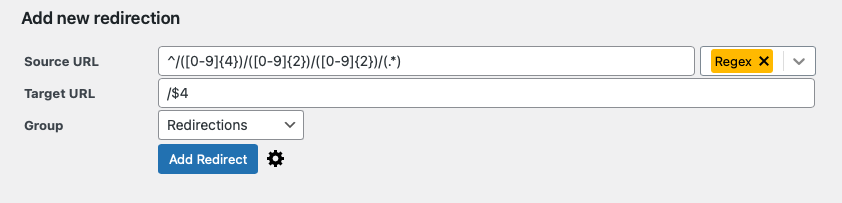
Source URL: ^/([0-9]{4})/([0-9]{2})/([0-9]{2})/(.*)
^/([0-9]{4})/([0-9]{2})/([0-9]{2})/(.*)
① ^/ “URL must start with /”
^/
② ([0-9]{4}) = Year (YYYY) → Captured in $1
([0-9]{4})
③ /([0-9]{2}) = Month (MM) → Captured in $2
/([0-9]{2})
④ /([0-9]{2}) = Day (DD) → Captured in $3
⑤ /(.*) = Slug portion (super important)
/(.*)
Capture Correspondence
Target URL: /$4Meaning
/$4
/
Basic Parts
Redirection Operation Rules
① URL with year/month/day → Slug only
WordPress permalink change (/%year%/%month%/%day%/ → /%postname%/)
② Move an entire directory structure to a different location
/old-blog/xxx → /blog/xxx
^/old-blog/(.*)
/blog/$1
③ Japanese URL → English slug (with sequential number)
^/ja/Japanese-title-([0-9]+)
/ja/english-title-$1
④ Remove index.php / index.html
^/(.*)/index\.(php|html?)$
/$1/
⑤ Remove trailing slash → Add trailing slash
^(.+[^/])$
$1/
⑥ http → https
^http://(.*)
https://$1
⑦ Upper-case URL → Lower-case URL
^/(.*[A-Z].*)
/$1
⑧ Redirect while ignoring query URLs
?utm_source=xxx
^/some-page/?$
/some-page/
⑨ Bulk rescue for URLs generating massive 404s
^/tag/(.*)
/blog/
⑩ Catch both ja and en (multilingual)
^/(ja|en)/(.*)
/$1/new-path/$2
How to create a landing page 1 – Custom Domain, Server, WordPress Installation
How to create a landing page 2 – WordPress Theme, Plugins, Elementor Basics
How to create a landing page 3 – Elementor practical Guide
How to create a landing page 4 – Header, Footer, Copyright
How to create a landing page 5 – Privacy Policy
How to create a landing page 6 – Contact Form